Israel election 2026: partial count puts Netanyahu bloc at 53, still short of majority
A 28 October partial count projected 53 seats for Netanyahu's bloc, 48 for Eisenkot's and 19 for Arab-led parties. The official allocation is not final.
Updated 28 October 2026 — partial count, not final results. Israel’s election has moved beyond the 51–51 exit-poll tie reported on election night. In a later provisional count, Benjamin Netanyahu’s bloc led Gadi Eisenkot’s bloc but remained short of a majority in the Knesset.
At 3:07 p.m. Israel time on Wednesday 28 October, The Times of Israel reported that Israel’s Central Elections Committee had announced these provisional seat estimates:
| Bloc or grouping | Seats projected from the partial count | Gap to 61 |
|---|---|---|
| Netanyahu-aligned bloc | 53 | 8 |
| Eisenkot-led bloc | 48 | 13 |
| Arab-led parties | 19 | Not part of either bloc’s agreed coalition |
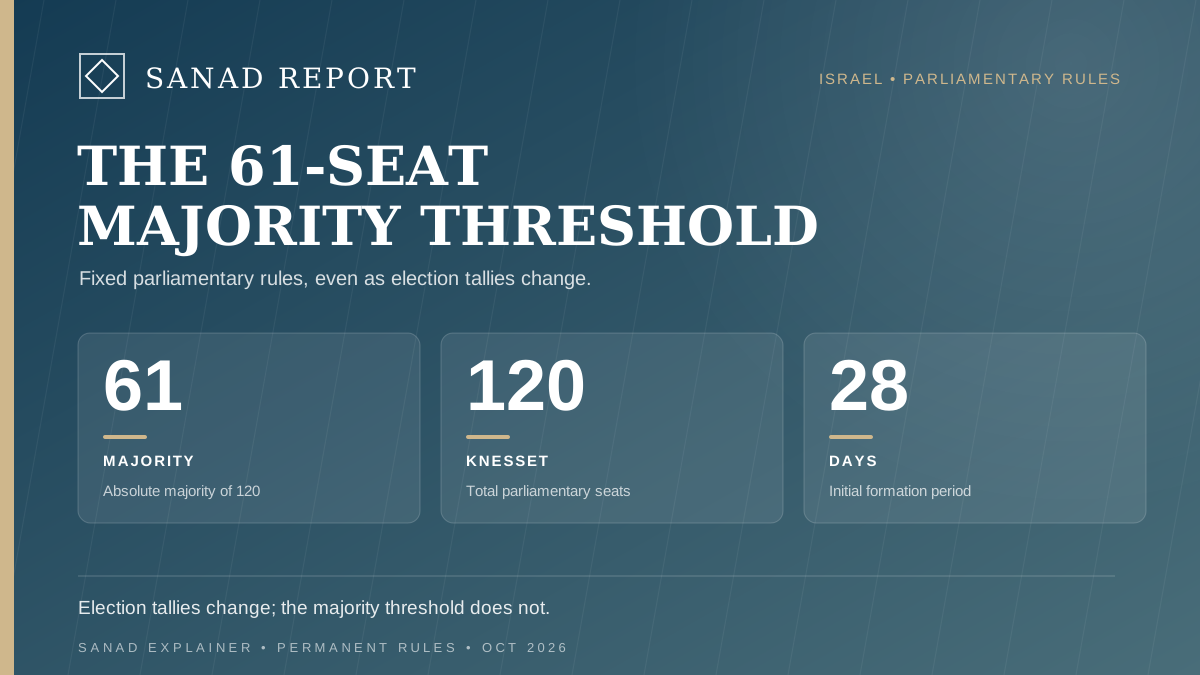
Sixty-one of the Knesset’s 120 seats is an absolute parliamentary majority. The three groups in this table add to 120, but the division into political blocs is not an official final election allocation or an announcement of any coalition agreement.
The committee’s announcement came after roughly 93% of ordinary ballots had been counted, equivalent to about 85.6% of the total vote, according to the report. Approximately 600,000 special double-envelope ballots — including votes cast by soldiers and others voting outside their regular polling places — had not yet been incorporated. Additional ordinary ballots also required checking.
How the numbers changed
Two television exit polls on 27 October initially had Netanyahu’s and Eisenkot’s respective blocs at 51 seats each. A third projected 52 for Netanyahu’s allies and 49 for his principal opponents, as Reuters reported. These were estimates based on people leaving polling stations, not counted ballots.
The later 53–48–19 figures come from ballots processed by election officials, with seats provisionally allocated. That makes them a more informative snapshot, not a declaration of final results. The figures can still change when the outstanding votes are counted.
Arab-led parties and the path to government
The Joint List and Ra’am were projected to command 19 seats together in the latest published snapshot. Those seats could matter greatly in coalition negotiations, but they do not automatically belong to Eisenkot’s grouping. Supporting a government without taking cabinet positions would also be different from formally joining a coalition.
Netanyahu has rejected depending on Arab-led parties to govern. Opposition leaders face their own differences over whether, and on what terms, those parties might support an alternative.
When results become final
The Association for Civil Rights in Israel’s election guide explains the formal counting and government-formation process. Official results were due to be published by 4 November 2026. After faction consultations, the president chooses a candidate to attempt to form a government. The initial formation period is 28 days, potentially extended by 14 days.
The illustration above shows the fixed majority and formation rules. It is not a live election-results graphic. The figures in the table represent the last snapshot verified for this article: 3:07 p.m. Israel time, 28 October 2026.
Sanad correction/update note (28 October): This report originally led with the 51–51 election-night exit polls and an early count. We replaced that lead with the later 53–48–19 partial count and corrected the AP source URL. No final result is being claimed. Our desk compared named published reporting and civic guidance; we have not independently processed the election commission’s raw ballots.
The sanad of this story
- With over 85% of votes counted, bloc projections 53–48–19, 28 October 2026 — The Times of Israel, reporting Central Elections Committee figures
- The Latest: Israel counts votes after no clear election winner — Associated Press
- Netanyahu and Eisenkot stake rival claims after deadlocked vote — Reuters
- After the Elections FAQ — Association for Civil Rights in Israel
Spotted an error? Request a correction. Read our editorial standards.
Related
Explainers · Middle East
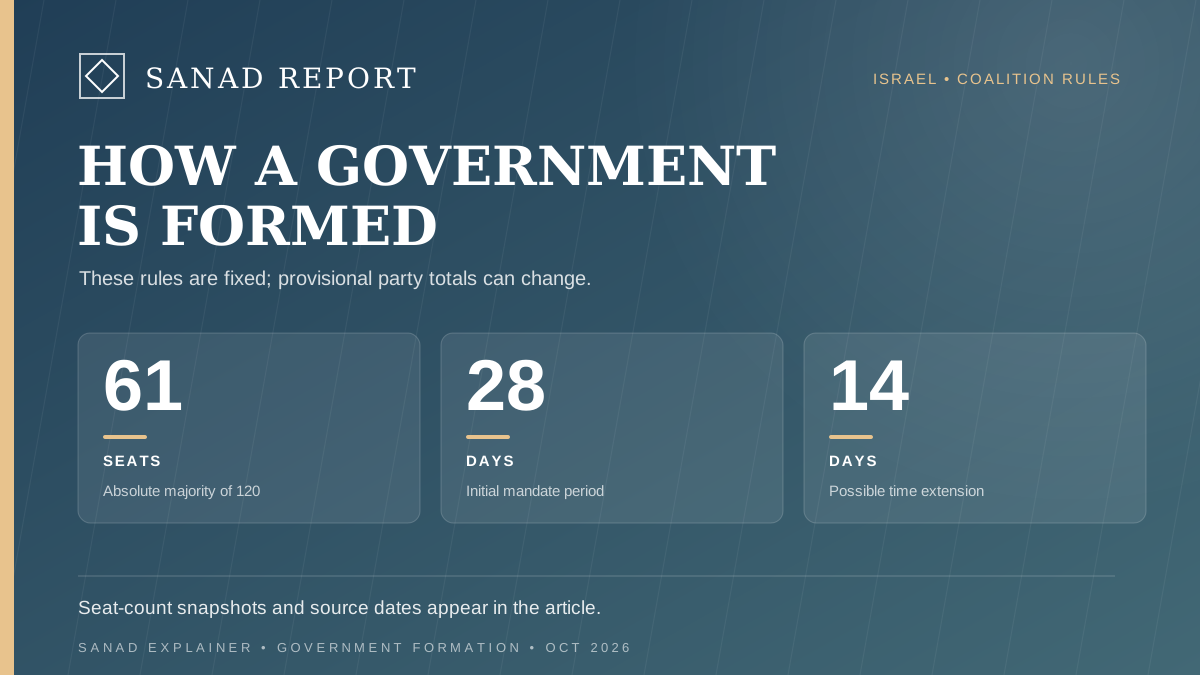
Israel election 2026: why 61 seats matter even as the count changes
The 61-seat majority threshold stays fixed while exit polls and partial tallies shift. The Arab parties' projected gains do not automatically settle who forms the government.

News · Latin America
Cuba embargo vote: UN records show support fell by 22 countries last year
Ahead of the 2026 vote, Sanad compared UN records from 2024 and 2025. Opposition, abstentions and absences all increased — but the figures alone cannot explain why.

News · Asia
Philippines AI hub: map request denied as Aeta families fear displacement
A public-records request sought the boundaries and energy plan for a 4,000-acre project. Government officials and Aeta residents dispute how many people may have to move.