Israel election 2026: why 61 seats matter even as the count changes
The 61-seat majority threshold stays fixed while exit polls and partial tallies shift. The Arab parties' projected gains do not automatically settle who forms the government.
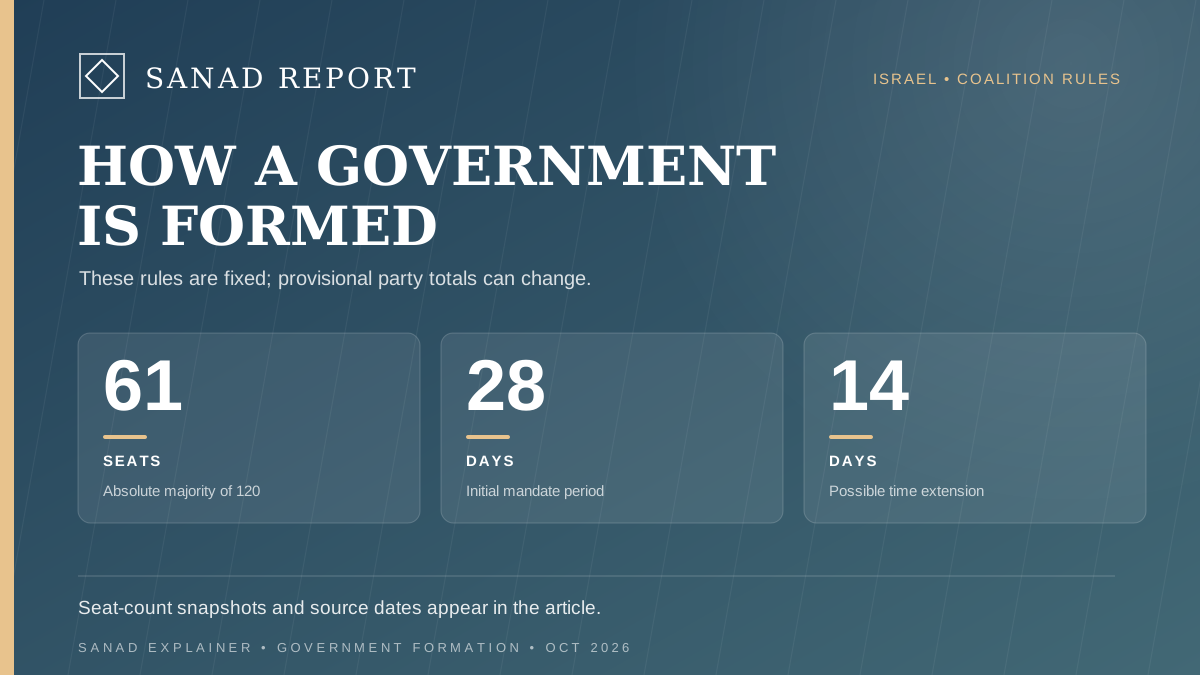
Sixty-one seats is the absolute-majority threshold in Israel’s 120-seat Knesset. That rule does not change when election estimates do. The practical question after the 27 October 2026 election is which leader can assemble enough parliamentary support to govern — not simply whose party or bloc led a particular television poll.
Sanad’s original election-night comparison showed a 51–51 tie in two broadcasters’ exit polls and a 52–49 division in a third, as Reuters documented. Those figures belonged to the night of 27 October, not to the later count.
By 3:07 p.m. Israel time on 28 October, The Times of Israel reported that the Central Elections Committee’s provisional allocation was different:
| Grouping in the 28 October partial count | Projected seats | Short of an absolute majority |
|---|---|---|
| Netanyahu-aligned bloc | 53 | 8 |
| Eisenkot-led bloc | 48 | 13 |
| Joint List and Ra’am together | 19 | Not pledged to either bloc |
These three categories total 120 seats, but they are political groupings rather than a declared government. With about 85.6% of total ballots included, the figures remained subject to changes when outstanding ordinary and special ballots were counted.
Why the Arab-led parties matter
Arab-led parties were projected to hold 19 seats. Whether those representatives could change the path to a government depends on choices they, Eisenkot, Netanyahu and other factions actually make, not on a hypothetical arithmetic sum.
A party can vote to support a government, remain outside a coalition or oppose both candidates. Those are different political decisions. No government was established by the partial tally alone.
For Palestinian citizens of Israel, the potential bargaining role of Arab-led parties matters, but winning seats does not guarantee policy commitments or inclusion in government. Their position should not be confused with the different legal and political circumstances of Palestinians in the West Bank and Gaza.
What happens after counting?
The Association for Civil Rights in Israel, the presidency and the Israel Democracy Institute describe the formal process: the president consults elected factions and selects the member considered most likely to form a government. That need not be the leader of the largest party.
The first nominee normally has 28 days to form a government, with a possible 14-day extension. Further attempts, a minority administration with outside support or another election may follow if no workable government emerges.
The 61 / 28 / 14 graphic on this page describes these parliamentary rules. It is deliberately not a live tally. The count above is a dated snapshot from 28 October at 3:07 p.m. Israel time, not a permanent seat allocation.
Sanad method/update note (28 October): We reproduced the coalition-seat deficits by subtracting provisional bloc estimates from 61. We added the later partial count after reviewing the committee’s figures as reported by The Times of Israel, and kept exit-poll results clearly dated as historical estimates. We did not inspect raw ballots or confirm any private coalition negotiations.
The sanad of this story
- With over 85% of votes counted, bloc projections 53–48–19, 28 October 2026 — The Times of Israel, reporting Central Elections Committee figures
- Netanyahu and Eisenkot after deadlocked election — Reuters
- After the Elections FAQ — Association for Civil Rights in Israel
- How Israel's president assigns government formation — Office of the President of Israel
- Elections 101: forming a government — Israel Democracy Institute
Spotted an error? Request a correction. Read our editorial standards.
Related
News · Middle East
Israel election 2026: partial count puts Netanyahu bloc at 53, still short of majority
A 28 October partial count projected 53 seats for Netanyahu's bloc, 48 for Eisenkot's and 19 for Arab-led parties. The official allocation is not final.
Explainers · Africa
Sudan famine warning explained: the three tests behind the IPC alert
Sanad compared the IPC's classification rules with October's WHO and UN warnings to show what is confirmed, what is forecast and where the evidence stops.