Sudan famine warning explained: the three tests behind the IPC alert
Sanad compared the IPC's classification rules with October's WHO and UN warnings to show what is confirmed, what is forecast and where the evidence stops.
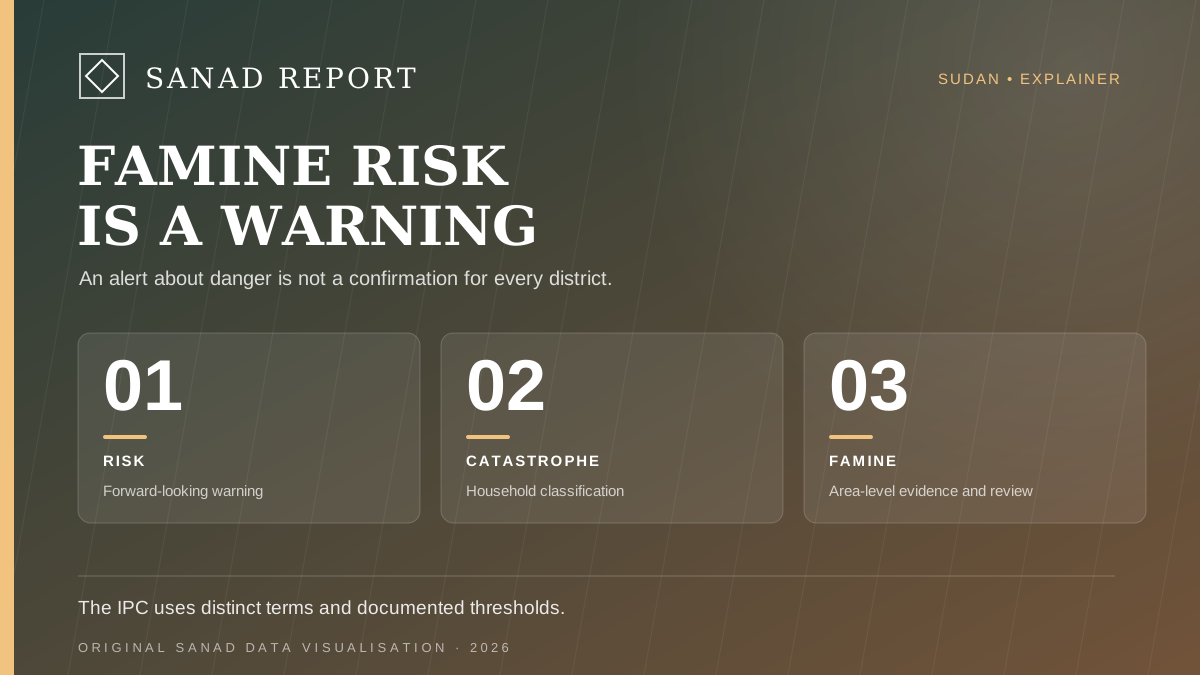
Sudan’s October famine alert poses an urgent question: has famine been confirmed in Darfur and Kordofan, or are experts warning that it could develop? The distinction changes the claim a headline can responsibly make. It does not change how urgently people need help.
On 12 October 2026, the Integrated Food Security Phase Classification (IPC) issued an alert about a growing risk of famine in parts of Greater Darfur and Greater Kordofan. The World Health Organization published the key findings: armed conflict, displacement, an El Niño-associated drought and inadequate funding were worsening an already dangerous situation.
Sanad compared that alert with the IPC’s own classification guidance. It shows three things that news coverage must not collapse into one.
Three terms that sound similar but are not
Risk of famine is a forward-looking assessment. The IPC says an area could realistically deteriorate into famine if circumstances become worse. It is not itself a famine classification.
Catastrophe (IPC Phase 5) describes conditions experienced by individual households. A household can face the most severe hunger even when the larger area has not been classified as being in famine.
Famine (IPC Phase 5) is an area-level classification based on evidence of extreme food deprivation, acute malnutrition and excess deaths. The IPC describes technical benchmarks that include extreme food gaps in more than 20% of households, acute malnutrition in more than 30% of children, and a crude death rate above two per 10,000 people daily. The system also has review protocols and rules for classifying famine with reasonable rather than complete evidence; these are not tests for a reporter to apply casually.
The IPC’s published famine facts explain why an alert about future danger should not be reported as proof that every locality already meets those thresholds.
What the two October notices actually say
WHO’s 12 October note says drought affected roughly half the country, reducing food availability and livelihoods. It also reports that 37% of health facilities had stopped functioning by 2026. Between January and August, WHO-supported nutrition centres helped treat more than 26,000 children with severe acute malnutrition and medical complications, according to the agency. These figures concern different indicators and periods; none by itself amounts to a new famine classification.
Four days later, UN humanitarian coordinator Denise Brown warned that, without urgent funding, humanitarian food and nutrition stocks were expected to run out by early 2027. That is a conditional forecast about aid supplies — not a statement that every distribution had already stopped.
What we can say is that the food, health and financing indicators point towards severe danger. What we cannot say from these notices is that famine has been newly confirmed in every part of Darfur and Kordofan.
Why the distinction matters
The IPC warns that remote, war-affected places often have the weakest data precisely because people cannot enter safely to measure conditions. Waiting for perfect evidence can cost lives; exaggerating what the evidence proves can also mislead families and donors.
The action recommended by the IPC and WHO is immediate: safe access for relief teams, protection for food and water systems, treatment for malnutrition and reliable funding. The warning exists so those measures can happen before the worst classification is reached.
How Sanad checked this: We compared WHO’s 12 October note and the UN’s 16 October statement with the IPC’s published definitions and review protocols. We have not conducted household surveys or independently classified any district.
The sanad of this story
- IPC Sudan Food Insecurity and Malnutrition Alert, 12 October 2026 — World Health Organization
- IPC frequently asked questions: famine thresholds and risk — Integrated Food Security Phase Classification
- IPC famine facts: risk, catastrophe and area classification — Integrated Food Security Phase Classification
- Severe rainfall deficits in Sudan, 16 October 2026 — United Nations in Sudan
Spotted an error? Request a correction. Read our editorial standards.
Related
Humanitarian · Africa
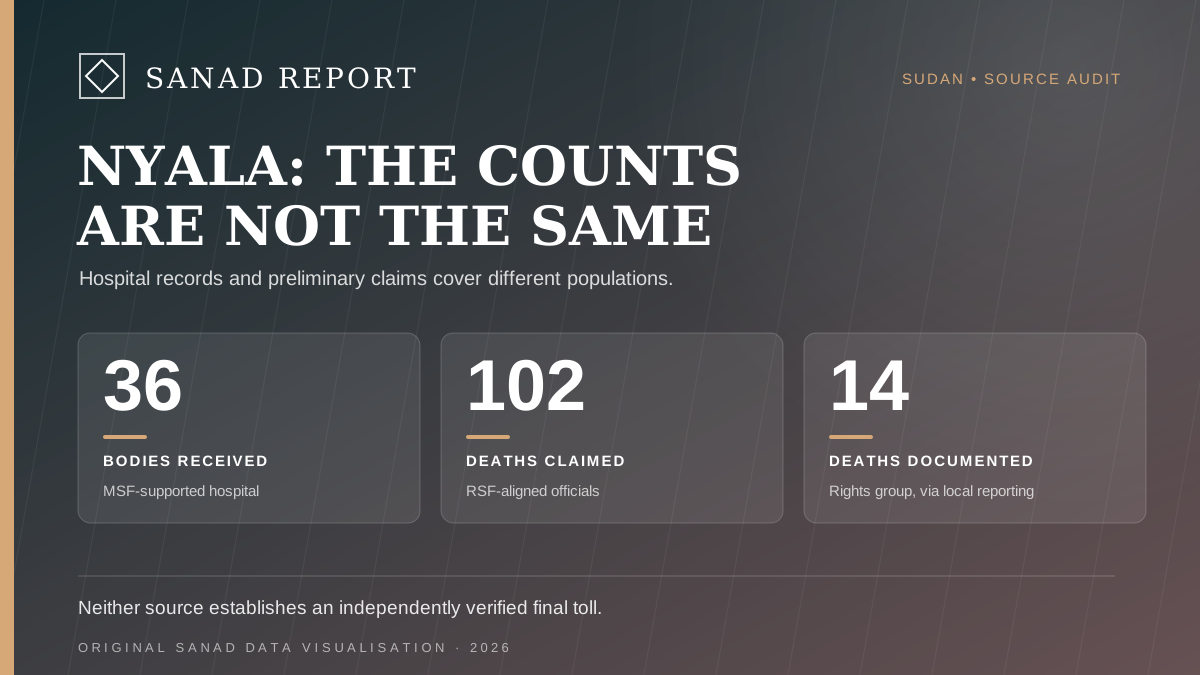
Nyala market attack: why hospital counts 36 bodies while officials claim 102 dead
Sanad compared MSF's hospital record, a local minister's preliminary toll and independent rights reporting. They measure different things, and no final verified total exists.
Opinion · Africa
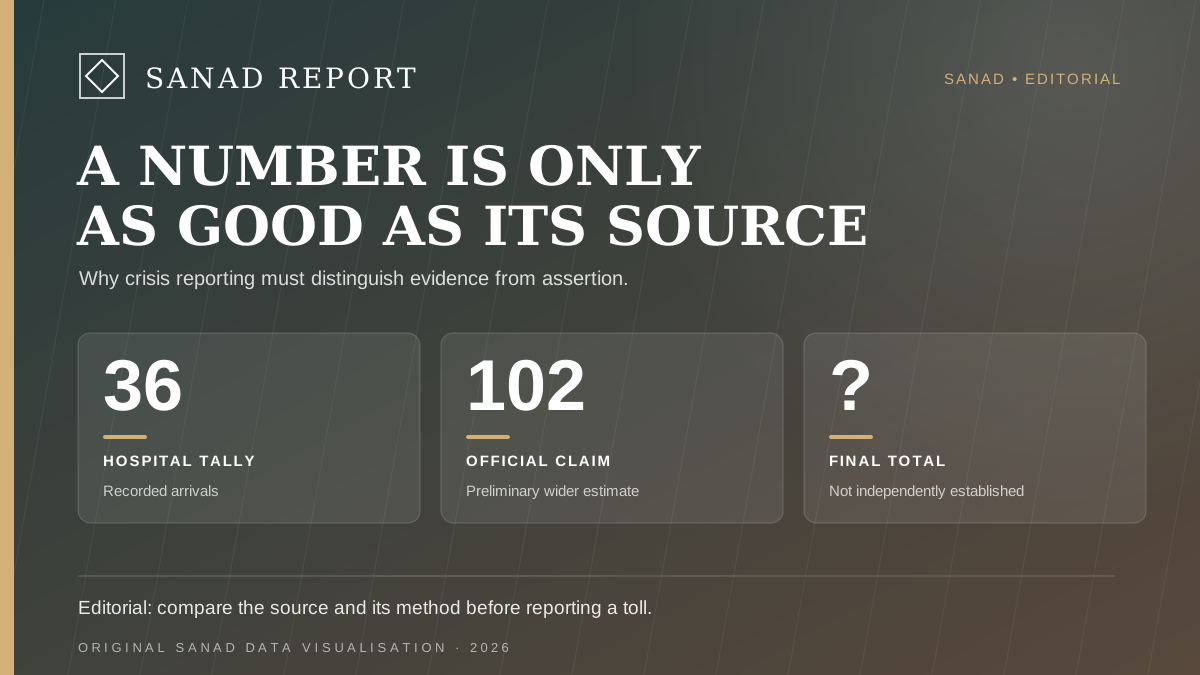
Sanad editorial: Sudan's dead deserve better than an unqualified number
Our review of Nyala reporting found figures drawn from hospital admissions, an interested administration and separate rights documentation. Publishing them as one confirmed total would be wrong.
Explainers · Middle East
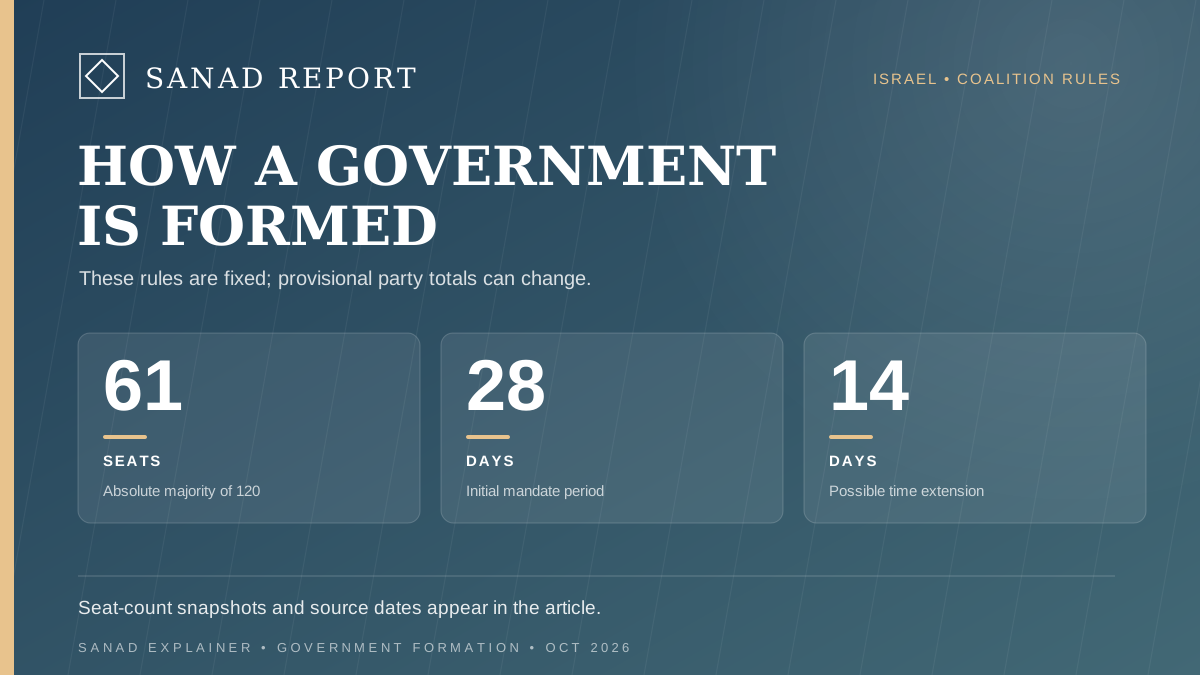
Israel election 2026: why 61 seats matter even as the count changes
The 61-seat majority threshold stays fixed while exit polls and partial tallies shift. The Arab parties' projected gains do not automatically settle who forms the government.